Boris Vallejo (born January 8, 1941) is a Peruvian-born American painter. He emigrated to the United States in 1964, and he currently resides in Allentown, Pennsylvania. He frequently works with Julie Bell, his wife, painter and model.
Vallejo works almost exclusively in the fantasy and erotica genres. His hyper-representational paintings have graced the covers of dozens of science fiction paperbacks and are featured in a series of best-selling glossy calendars. Subjects of his paintings are typically gods, monsters, and well-muscled male and female barbarians engaged in battle. Some of his male figures were modeled by Vallejo himself, and many of his later female characters were modeled by his wife. His latest works still retain heavy fantasy elements, but lean more towards the erotic rather than pure fantasy themes. (wikipedia)
Μετά τον Α’ Παγκόσμιο πόλεμο, την περίοδο της Βαϊμάρης στη Γερμανία υπήρξε μια τάση να αισθητικοποιηθεί το σεξουαλικό έγκλημα, ειδικά μετά από κάποια σειρά τέτοιων πραγματικών φόνων που συντάραξαν την κοινωνία. Πολλοί καλλιτέχνες, με πιο εξέχοντες τους Otto Dix και George Gorsz, παρήγαναν έναν αξιοσημείωτα μεγάλο αριθμό σχετικών έργων (πίνακες, σχέδια, φωτογραφήσεις, κλπ) με τέτοια σοκαριστική θεματολογία, είτε σε μια προσπάθεια να εξερευνήσουν την άβυσσο του ασυνείδητού τους, είτε με προκλητική διάθεση απέναντι στην κοινωνική κρίση του μεσοπολέμου στη Γερμανία και την ασταθή δημοκρατία της Βαϊμάρης. Ένα ενδιαφέρον βιβλίο που ερευνά διαχρονικά το σεξουαλικό έγκλημα με αφετηρία αυτά τα έργα της περιόδου της Βαϊμάρης είναι το Lustmord: “Sexual Murder in Weimar Germany” της Maria Tatar.
Otto Dix"Lustmord"
Η νοσηρή περιέργεια και ενδιαφέρον για το σεξουαλικό έγκλημα αποδίδεται πολύ παραστατικά στη γερμανική λέξη του σεξουαλικού εγκλήματος Lustmord (αντλώντας ηδονή από το θάνατο) και ο τρόπος αναπαράστασης αυτών των φόνων προκαλεί συγχρόνως ανάμικτα αισθήματα απώθησης και γοητείας. Οι αναπαραστάσεις αυτές είναι, από τη μια μεριά, καθηλωτικές μέσα από την παραμορφωτική αποστασιοποιημένη απεικόνιση της βίας που κινητοποιεί σεξουαλικές φαντασιώσεις, και από την άλλη, απωθητικές λόγω της νοσηρής ασελγούς εικόνας τους.
Δεν είναι φυσικά περιορισμένο το φαινόμενο μόνο στην περίοδο της Βαϊμάρης, αν και εκείνη την εποχή, με την εκρηκτική πρόοδο της τέχνης, του απόγειου της ψυχανάλυσης και της γνώσης του ασυνείδητου, δικαιολογείται η αναζωπύρωση τέτοιου ενδιαφέροντος σε συνδυασμό, μάλιστα, με την άσχημη κοινωνική και πολιτική κατάσταση.
Otto Dix "Lustmord" (1922)
After the World War I in Weimar rebublic in Germany, there is a tension to aeshetize sexual murders, especially after some such actual murders that shocked society. Many artists produced a noticeable large number of drawings, painting or photos with such disturbing gory thematology, either exploring their dark side of their unconscious desires, or with an attitude to provoke by giving a grotesque vision of the after war social crisis in Weimar. An interesting book which investigates sexual murder in history (Lustmord in German) is that of Maria Tatar: Lustmord: “Sexual Murder in Weimar Germany” by focusing on the two most famous artists who dealt with Lustmord in their paintings” Otto Dix and George Grosz. We read about this book:
Rene Magritte "The Menaced Assasin" (1927)
Tatar focuses attention on the politically turbulent Weimar Republic, often viewed as the birthplace of a transgressive avant-garde modernism, where representations of female sexual mutilation abound…. Tatar show that male artists openly identified with real-life sexual murderers--George Grosz posed as Jack the Ripper in a photograph where his model and future wife was the target of his knife--but she also reveals the ways in which victims were disavowed and erased.
Otto Dix"Lustmord" (1922)
Tatar first analyzes actual cases of sexual murder that aroused wide public interest in Weimar Germany. She then considers how the representation of murdered women in visual and literary works functions as a strategy for managing social and sexual anxieties, and shows how violence against women can be linked to the war trauma, to urban pathologies, and to the politics of cultural production and biological reproduction.
George Grosz, as Jack the Ripper, Self-Portrait with Eva Peters in the Artist's Studio, 1918
In her book Lustmord: Sexual Murder in Weimar Germany, Maria Tater investigates the gender politics of cultural production in Germany during the pre- World War II era, specifically as it operated through the artistic representations of sexual murder or lustmord made popular by George Grosz and Otto Dix. This period has been referred to as one of a modernist movement in art that aestheticized violence and was funded by a transgressive energy that marks the avant- garde.
Rudolph Schlichter"Lustmord" (1924)
Tater, however, reads the situation of sexual murder in the art work of Weimar Germany as more than an avant-garde aesthetic convention or genre. She argues that it is symptomatic of a culture that views women as icons of licentious sexuality, threats to masculinity, and as mothers as agents against sexual prohibitions.
Realistic Lustmord painting by Anomymous from the book: Voluptuous Panic: The Erotic World of Weimar Berlin by Mel Gordon
Tater makes clear that the representations of sexual murder are not just eviscerated female bodies in lewd positions, but that the subject matter is lustful. The German term Lustmord implies desire or pleasure along with sexual gain from the murderous act or representation. Women are represented as mutilated female bodies which are objects of both fascination and dread. Such representations are both riveting in their displays of disfiguring violence, and also repugnant in the detail of morbid carnality.
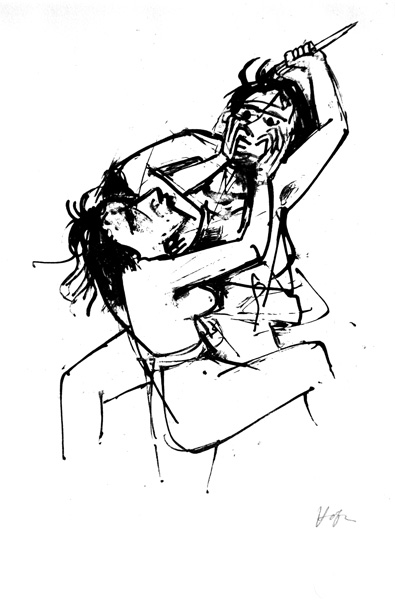
Carl Hofer "Lustmord" (1923)
Heinrich-Maria Davinghausen (1894 -1970) Sex Murdrerer
Αλλά πάντα από την αποστα- σιοποιημένη ματιά της τέχνης
Εργα τέχνης που απεικονίζουν σκοτεινές πλευρές της ιστορίας και του ανθρώπινου ψυχισμού, όπως ωμή βία, ρατσισμό, κακοποίηση και σφαγές άλλων -ΔΕΝ ΠΡΕΠΕΙ ΝΑ ΛΟΓΟΚΡΙΝΟΝΤΑΙ!! Πρέπει να αντιμετωπίζουμε πρόσωπο με πρόσωπο την ωμότητα και να πασχίζουμε να την κατανοήσουμε με κριτικό και αποστασιοποιημένο τρόπο, αν θέλουμε να φτιάξουμε έναν καλύτερο κόσμο.
Graphics that depict dark aspects of history—such as violence, intolerance, racism, aggressive nationalism, war and atrocity, abuse of others and of the environment in general—have not been censored. We must confront such harsh images directly—and struggle to critically understand them—if we hope to ever make a better world. ocw.mit.edu
Metal inspired art, or art that inspired metal and anything about thematology of macabre and horror in art, in life, in history, etc. Languages: english and greek
Firenze, Ottobre 2026
-
Di Firenze si è scritto e letto già tutto. Non serve aggiungere altro. Lo
stesso si può dire delle immagini che non possono che essere sempre le
stess...
Gruss Vom Krampus
-
*Gruss Vom Krampus*
Le "Krampuslauf" est une ancienne tradition alpine de plus de 500 ans (à
prédominance autrichienne), elle fut développée sur base de...
Edgar Allan Poe’s Birthday
-
Τα Reflections και το Death Disco πιστά στο ετήσιο ραντεβού τους με τον
πρίγκηπα του Τρόμου επιστρέφουν επίσημα για το 2020 με μια βραδιά
αφιερωμένη σε γεγ...
Le Cimitere du Monastère de Ciemetz, Nice
-
This is the second cemetery we visited in Nice. It's life began as a
monastery and that is more or less the only information i was able to dig
out.
It's ...
Crouching and Screaming
-
Wonderful 1978 illustrations by Outi Markkanen (Finland, b.1951) on Kuriosas.
Visit the link for many more illustrations from *Kurnau ja Kamaluu*.
Humble Heather
-
*Early 19th century hand-coloured *
*engravings of heath flowers*
The vast majority of the 860+ species in the genus Erica (heaths/heather)
are endemic t...
Sherry Lee Short
-
Sherry Lee Short
Sherry Lee Short is an artist, teacher, writer, and activist. She received
her Master of Fine Arts with Distinction from the...
Battesimi pericolosi
-
Castrillo de Murcia è un piccolo borgo di 500 anime nella provincia di
Burgos, nella Spagna del Nord. Il paesino è sonnacchioso, e non vi succede
nulla di ...
UPDATE!!
-
The Art of the Beautiful~Grotesque Posterous which fed this blog has now
been deleted (along with all other Posterous blogs, Twitter directly to
blame)...
The Wellcome Library website is changing…
-
On Wednesday, 21st November, visitors to the Wellcome Library website will
notice that we’ve made some changes. We’ve given the whole site an
overhaul, wit...