
 George Gorsz "John the Sex Murderer" (1918)
Μετά τον Α’ Παγκόσμιο πόλεμο, την περίοδο της Βαϊμάρης στη Γερμανία υπήρξε μια τάση να αισθητικοποιηθεί το σεξουαλικό έγκλημα, ειδικά μετά από κάποια σειρά τέτοιων πραγματικών φόνων που συντάραξαν την κοινωνία. Πολλοί καλλιτέχνες, με πιο εξέχοντες τους Otto Dix και George Gorsz, παρήγαναν έναν αξιοσημείωτα μεγάλο αριθμό σχετικών έργων (πίνακες, σχέδια, φωτογραφήσεις, κλπ) με τέτοια σοκαριστική θεματολογία, είτε σε μια προσπάθεια να εξερευνήσουν την άβυσσο του ασυνείδητού τους, είτε με προκλητική διάθεση απέναντι στην κοινωνική κρίση του μεσοπολέμου στη Γερμανία και την ασταθή δημοκρατία της Βαϊμάρης. Ένα ενδιαφέρον βιβλίο που ερευνά διαχρονικά το σεξουαλικό έγκλημα με αφετηρία αυτά τα έργα της περιόδου της Βαϊμάρης είναι το Lustmord: “Sexual Murder in Weimar Germany” της Maria Tatar.
 Otto Dix "Lustmord"
Η νοσηρή περιέργεια και ενδιαφέρον για το σεξουαλικό έγκλημα αποδίδεται πολύ παραστατικά στη γερμανική λέξη του σεξουαλικού εγκλήματος Lustmord (αντλώντας ηδονή από το θάνατο) και ο τρόπος αναπαράστασης αυτών των φόνων προκαλεί συγχρόνως ανάμικτα αισθήματα απώθησης και γοητείας. Οι αναπαραστάσεις αυτές είναι, από τη μια μεριά, καθηλωτικές μέσα από την παραμορφωτική αποστασιοποιημένη απεικόνιση της βίας που κινητοποιεί σεξουαλικές φαντασιώσεις, και από την άλλη, απωθητικές λόγω της νοσηρής ασελγούς εικόνας τους.
Δεν είναι φυσικά περιορισμένο το φαινόμενο μόνο στην περίοδο της Βαϊμάρης, αν και εκείνη την εποχή, με την εκρηκτική πρόοδο της τέχνης, του απόγειου της ψυχανάλυσης και της γνώσης του ασυνείδητου, δικαιολογείται η αναζωπύρωση τέτοιου ενδιαφέροντος σε συνδυασμό, μάλιστα, με την άσχημη κοινωνική και πολιτική κατάσταση.
 Otto Dix "Lustmord" (1922)
After the World War I in Weimar rebublic in Germany, there is a tension to aeshetize sexual murders, especially after some such actual murders that shocked society. Many artists produced a noticeable large number of drawings, painting or photos with such disturbing gory thematology, either exploring their dark side of their unconscious desires, or with an attitude to provoke by giving a grotesque vision of the after war social crisis in Weimar. An interesting book which investigates sexual murder in history (Lustmord in German) is that of Maria Tatar: Lustmord: “Sexual Murder in Weimar Germany” by focusing on the two most famous artists who dealt with Lustmord in their paintings” Otto Dix and George Grosz. We read about this book:
 Rene Magritte "The Menaced Assasin" (1927)
Tatar focuses attention on the politically turbulent Weimar Republic, often viewed as the birthplace of a transgressive avant-garde modernism, where representations of female sexual mutilation abound…. Tatar show that male artists openly identified with real-life sexual murderers--George Grosz posed as Jack the Ripper in a photograph where his model and future wife was the target of his knife--but she also reveals the ways in which victims were disavowed and erased.
 Otto Dix "Lustmord" (1922)
Tatar first analyzes actual cases of sexual murder that aroused wide public interest in Weimar Germany. She then considers how the representation of murdered women in visual and literary works functions as a strategy for managing social and sexual anxieties, and shows how violence against women can be linked to the war trauma, to urban pathologies, and to the politics of cultural production and biological reproduction.
 George Grosz, as Jack the Ripper,
Self-Portrait with Eva Peters
in the Artist's Studio, 1918
Also on an essay with the same subject we read:
 Otto Dix "Lustmord" (1922)
In her book Lustmord: Sexual Murder in Weimar Germany, Maria Tater investigates the gender politics of cultural production in Germany during the pre- World War II era, specifically as it operated through the artistic representations of sexual murder or lustmord made popular by George Grosz and Otto Dix. This period has been referred to as one of a modernist movement in art that aestheticized violence and was funded by a transgressive energy that marks the avant- garde.
 Rudolph Schlichter "Lustmord" (1924)
Tater, however, reads the situation of sexual murder in the art work of Weimar Germany as more than an avant-garde aesthetic convention or genre. She argues that it is symptomatic of a culture that views women as icons of licentious sexuality, threats to masculinity, and as mothers as agents against sexual prohibitions.
 Realistic Lustmord painting by Anomymous
from the book: Voluptuous Panic:
The Erotic World of Weimar Berlin by Mel Gordon
Tater makes clear that the representations of sexual murder are not just eviscerated female bodies in lewd positions, but that the subject matter is lustful. The German term Lustmord implies desire or pleasure along with sexual gain from the murderous act or representation. Women are represented as mutilated female bodies which are objects of both fascination and dread. Such representations are both riveting in their displays of disfiguring violence, and also repugnant in the detail of morbid carnality.
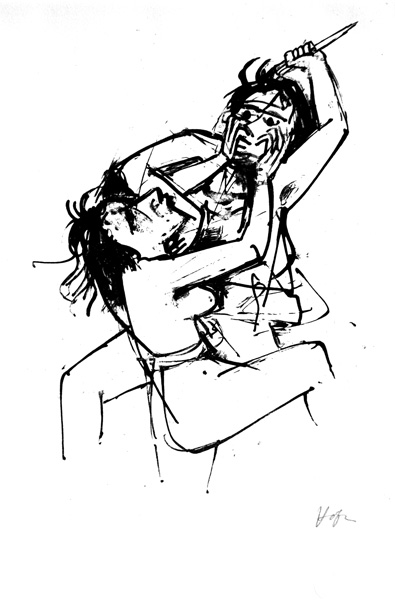 Carl Hofer "Lustmord" (1923)
+Sex+Murdrerer.jpg) |
| Heinrich-Maria Davinghausen (1894 -1970) Sex Murdrerer |


.jpg)


