Walpurgis Night (Walpurgisnacht) is a traditional spring festival on 30 April or 1 May in large parts of Central and Northern Europe. It is often celebrated with dancing and with bonfires. It is exactly six months from All Hallows' Eve. In Germany, Walpurgisnacht, the night from 30 April to 1 May, is the night when witches are reputed to hold a large celebration on the Brocken and await the arrival of spring. Walpurgis Night (in German folklore) the night of 30 April (May Day's eve), when witches meet on the Brocken mountain and hold revels and orgies with the Devil. Around the summit of the Brocken, the witches dance for the Devil, who then selects one of the witches to be his Bride for the year. Brocken is the highest of the Harz Mountains of north central Germany. It is noted for the phenomenon of the Brocken spectre and for witches' revels which reputedly took place there on Walpurgis night.
Dave Lipscomb for Belialian Woman By Hydra M. Star
Franz Xaver Simm (1853-1918) for Faust
Johannes Praetorius Blockes-Berges Verrichtung, Leipzig u.a. 1668
Faust performance poster, 1887
A scene in Goethe's Faust Part One is called "Walpurgisnacht," and one in Faust Part Two is called "Classical Walpurgisnacht." The last chapter of book five in Thomas Mann's The Magic Mountain is also called "Walpurgisnacht." In Edward Albee's 1962 play Who's Afraid of Virginia Woolf?, Act Two is entitled "Walpurgisnacht."
From Bram Stoker's short story, "Dracula's Guest," an Englishman is on a visit to Munich before leaving for Transylvania. It is Walpurgis Night, and in spite of the hotelier's warning not to be late coming back, the young man later leaves his carriage and wanders toward the direction of an abandoned "unholy" village. As the carriage departs with the frightened and superstitious driver, a tall and thin stranger scares the horses at the crest of a hill.
W. Jury after Johann Heinrich Ramberg Walpurgisnacht scene in Faust (1829)
Walpurgisnacht, Gemälde von Albert Welti (1897)
Witches flying to Sabbat by Bernard Zuber Woodblock print 1926
Johfra: Witches Sabbath (1977)
Émile-Antoine Bayard (1870)
Francisco Goya (1797-1798)
Jacob Corneliszoon van Oostsanen (1526)
Stefan Eggeler's etchings for Gustav Meyrink's Walpurgisnacht (1922):
The 19th century image of a Sabbatic Goat, created by Eliphas Lévi. The arms bear the Latin words SOLVE (dissolve) and COAGULA (congeal).
Baphomet is an imagined pagan deity (i.e., a product of Christian folklore concerning pagans), revived in the 19th century as a figure of occultism and Satanism. It first appeared in 11th and 12th century Latin and Provençal as a corruption of "Mahomet", the Latinisation of "Muhammad", but later it appeared as a term for a pagan idol in trial transcripts of the Inquisition of the Knights Templar in the early 14th century. The name first came into popular English-speaking consciousness in the 19th century, with debate and speculation on the reasons for the suppression of the Templars.
Old drawing after Eliphas Lévi’s Baphomet by an unkown artist, around 1890
Since 1855, the name Baphomet has been associated with a "Sabbatic Goat" image drawn by Eliphas Lévi. It represents the duality of male and female, as well as Heaven and Hell or night and day signified by the raising of one arm and the downward gesture of the other. It can be taken in fact, to represent any of the major harmonious dichotomies of the cosmos.
Eliphas Lévi published "Dogme et Rituel de la Haute Magie", in which he included an image he had drawn himself which he described as Baphomet and "The Sabbatic Goat", showing a winged humanoid goat with a pair of breasts and a torch on its head between its horns. This image has become the best-known representation of Baphomet. Lévi considered the Baphomet to be a depiction of the absolute in symbolic form and explicated in detail his symbolism in the drawing that served as the frontispiece:
The goat on the frontispiece carries the sign of the pentagram on the forehead, with one point at the top, a symbol of light, his two hands forming the sign of occultism, the one pointing up to the white moon of Chesed, the other pointing down to the black one of Geburah. This sign expresses the perfect harmony of mercy with justice. His one arm is female, the other male like the ones of the androgyne of Khunrath, the attributes of which we had to unite with those of our goat because he is one and the same symbol. The flame of intelligence shining between his horns is the magic light of the universal balance, the image of the soul elevated above matter, as the flame, whilst being tied to matter, shines above it. The beast's head expresses the horror of the sinner, whose materially acting, solely responsible part has to bear the punishment exclusively; because the soul is insensitive according to its nature and can only suffer when it materializes. The rod standing instead of genitals symbolizes eternal life, the body covered with scales the water, the semi-circle above it the atmosphere, the feathers following above the volatile. Humanity is represented by the two breasts and the androgyne arms of this sphinx of the occult sciences.
Lévi's depiction, for all its modern fame, does not match the historical descriptions from the Templar trials, although it may also have been partly inspired by grotesque carvings on the Templar churches of Lanleff in Brittany and Saint-Merri in Paris, which depict squatting bearded men with bat wings, female breasts, horns and the shaggy hindquarters of a beast, as well as Viollet-le-Duc's vivid gargoyles that were added to Notre Dame de Paris about the same time as Lévi's illustration.
The Baphomet of Lévi was to become an important figure within the cosmology of Thelema, the mystical system established by Aleister Crowley in the early twentieth century. Baphomet has been also connected with Satanism as well, primarly due to the adoption of its symbol by the Church of Satan.
Leo Taxil's poster for his hoax book about Freemasons and its public reveal depict Levi's Baphomet illustration
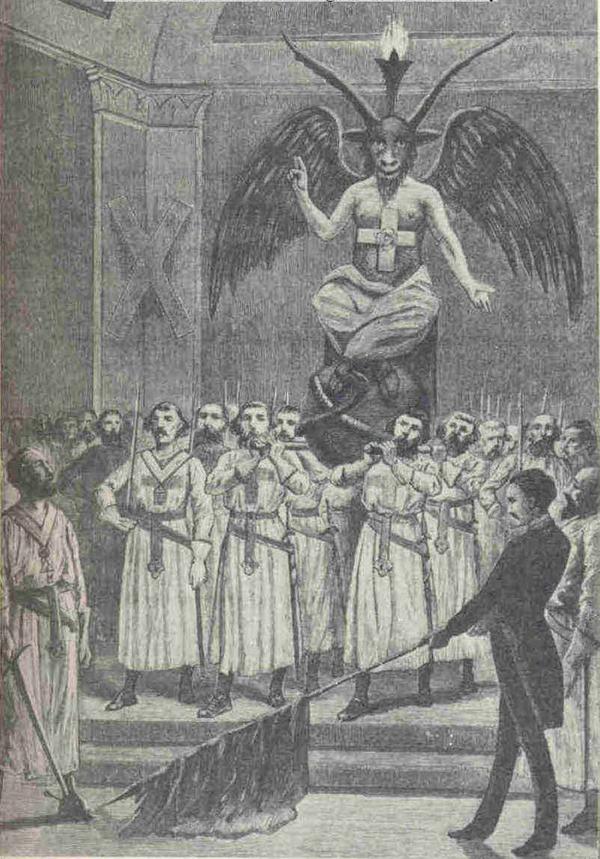
In 1885 Leo Taxil professed conversion to Catholicism, was solemnly received into the church, and renounced his earlier works. In the 1890s he wrote a series of pamphlets and books denouncing Freemasonry, charging their lodges with worshiping the devil (depicted as Levi's description and illustration of Bathomet) and alleging that Diana Vaughan had written for him her confessions of the Satanic "Palladism" cult. That book had great sales among Catholics, although Diana Vaughan never appeared in public. In 1892 Taxil also began to publish a paper La France chrétienne anti-maçonnique. In 1887 he had an audience with Pope Leo XIII, who rebuked the bishop of Charleston for denouncing the anti-Masonic confessions as a fraud and in 1896 sent his blessing to an anti-Masonic Congress in Trent.
Baphomet at a Freemason session. Picture from a hoax book by Leo Taxil (1890)
Doubts about Vaughan's veracity and even her existence began to grow, and finally Taxil promised to produce her at a lecture to be delivered by him on April 19, 1897. To the amazement of the audience (which included a number of priests), he announced that Diana was one of a series of hoaxes. He had begun, he said, by persuading the commandant of Marseille that the harbour was infested with sharks, and a ship was sent to destroy them. Next he invented an underwater city in Lake Geneva, drawing tourists and archaeologists to the spot. He thanked the bishops and Catholic newspapers for facilitating his crowning hoax, namely his conversion, which had exposed the anti-Masonic fanaticism of many Catholics. Diana Vaughan was revealed to be a simple typist in his employ, who laughingly allowed her name to be used by him.
The audience received these revelations with indignation and contempt, and Taxil was mobbed on leaving the hall so that policemen had to escort him to a neighbouring café. He then moved away from Paris. He died in Sceaux in 1907.
Hellmouth is the entrance to Hell envisaged as the gaping mouth of a huge monster, an image which first appears in Anglo-Saxon art, and then spread all over Europe, remaining very common in depictions of the Last Judgment and Harrowing of Hell until the end of the Middle Ages, and still sometimes used during the Renaissance and after. It enjoyed something of a revival in polemical popular prints after the Protestant Reformation, when figures from the opposite side would be shown disappearing into the mouth. A notable late appearance is in the two versions of a painting by El Greco of about 1578. Political cartoons still showed Napoleon leading his troops into one. Medieval theatre often had a hellmouth prop or mechanical device which was used to attempt to scare the audience by vividly dramatizing an entrance to Hell.
The Hours of Catherine of Cleves 1440
The Hours of Catherine of Cleves 1440
Taddeo di Bartolo (1396)
St. Augustine's manuscript De civitate Dei libri XXII (The city of God), 412-426
14th century Bolognese painting
The oldest example of an animal Hellmouth known to Meyer Schapiro was an ivory carving of c. 800 in the Victoria and Albert Museum, and he says most examples before the 12th century are English. Many show the Harrowing of Hell, which appealed to Anglo-Saxon taste, as a successful military raid by Christ. Schapiro speculates that the image may have drawn from the pagan myth of the Crack of Doom, with the mouth that of the wolf-monster Fenrir, slain by Vidar, who is used as a symbol of Christ on the Gosforth Cross and other pieces of Anglo-Scandinavian art. In the assimilation of Christianised Viking populations in northern England, the Church was surprisingly ready to allow the association of pagan mythological images with Christian ones, in hogback grave markers for example. In the Anglo-Saxon Vercelli Homilies (4:46-8) Satan is likened to a dragon swallowing the damned
Fra Angelico 1435-1440
Fra Angelico 1431
The whale-monster Leviathan has been equated with this description, although this is hard to confirm in the earliest appearances. However in The Whale, an Old English poem from the Exeter Book, the mouth of Hell is compared to a whale's mouth, though somewhat indirectly: The whale has another trick: when he is hungry, he opens his mouth and a sweet smell comes out. The fish are tricked by the smell and they enter into his mouth. Suddenly the whale’s jaws close. Likewise, any man who lets himself be tricked by a sweet smell and led to sin will go into hell, opened by the devil — if he has followed the pleasures of the body and not those of the spirit. When the devil has brought them to hell, he clashes together the jaws, the gates of hell. No one can get out from them, just as no fish can escape from the mouth of the whale.
Codex Gigas 13th cent
Master of the Parlament de Paris, , France
Giovanni da Modena (ca. 1410)
Book of Revelation 1430-1440
Satan himself is often shown sitting in Hell eating the damned, but according to G.D. Schmidt this is a separate image, and the Hellmouth should not be considered to be the mouth of Satan, although Hofmann is inclined to disagree with this. Equally the Hellmouth never bites the damned, remaining wide open, ready for more.
Necropants are a gruesome and unsettling method that a sorcerer used to get rich in old Iceland. With agreement prior to death, the sorcerer exhumed the corpse of a man and flayed its skin, in one piece, from the waist down. From Lonely Planet Iceland: It was believed that the necropants would spontaneously produce money when worn, as long as the donor corpse had been stolen from a graveyard at the dead of night and a magic rune and a coin stolen from a poor widow were placed in the dead man’s scrotum..
The Islandic magical stave for necropants
After tanning, the sorcerer wore the skin like a pair of pants. As soon as he stepped into the pants they will stick to his own skin. A coin must be stolen from a poor widow and placed in the scrotum along with a magical sign (stave), written on a piece of paper. This reputedly attracted more coins and hence the sorcerer became wealthy.
Before his death, the sorcerer had to pass the necropants to another. He did this by having the new owner place his right leg in one side of the pants whilst the sorcerer still has his left leg in the other. In this way, the power of the pants would pass from one individual to another. The Museum of Witchcraft and Sorcery in Iceland has a pair of necropants on display.
An ex-voto is a votive offering to a saint or divinity. It is given in fulfillment of a vow (hence the Latin term, short for ex voto suscepto, "from the vow made") or in gratitude or devotion. Ex-votos are placed in a church or chapel where the worshipper seeks grace or wishes to give thanks. They are not only intended for the helping figure, but also as a testimony to later visitors of the received help. As such they may include texts explaining a miracle attributed to the helper, or symbols such as a painted or modelled reproduction of a miraculously healed body part, or a directly related item such as a crutch given by a person formerly lame.
Healing and faith have always played a role in the lives of the faithful. They are interwoven in the fabric of social history. How we regard illness and healing, and how we cope with them have captured our imagination throughout the ages. The expression of our relationship with illness is wonderfully illustrated in the ex-voto, a devotional painting giving thanks to a saint or deity for a miraculous healing or a blessing. The faithful have always used prayer to invoke the aid of saints as a means to heal the sick and end one’s suffering. These devotional paintings are an individual’s expression of thanks for the intercession of the divine in a crisis, a snapshot in time of illness and healing. They offer a rare opportunity to view health, healing, and illness through the hearts and minds of the ordinary person.
From its beginnings in 15th century Italy through its spread to the New World in the 16th century, ex-votos have played a role in the daily lives of the faithful especially in Mexico. When many people think of exvotos in Mexico, they think of those painted on tin or sheet metal. This use of tin started in the 19th century and are the majority of the pictures I post. These exvotos are generally around a foot in length, and were often painted by a local artist or artisan for the giver, who may not have been able to read and write. Most Mexican exvotos have a detailed explanation of why the donor is giving thanks.
They continued to be a popular expression of faith and healing into the late 18th and early 19th centuries, the most prolific period of ex-voto production. Although the ex-voto experienced a decline in the 20th century, the faithful still continue to commission artists to create them today. Most remain a personalized expression of thanks for a healing or a restoration of health, but their purpose has expanded to include the commemoration of a special event or to address a concern in an individual’s life. Ex-votos continue to be a reflection of a tradition where faith and healing play a vital role in daily life.U.S. National Library of Medicine
Πρόκειται για τα γνωστά σε εμάς τάματα ή αναθήματα. Τα υπό παρουσίαση αφορούν καλλιτεχνήματα που αφιερώνονται στο Θείο ως ένδειξη ευγνωμοσύνης που εισακούστηκαν οι προσευχές και θεραπεύτηκε ο ασθενής, είτε με τη βοήθεια της ιατρικής, είτε και επιστημονικά ανεξήγητα ως "θαύμα". Η ποικιλία αυτών των αναθημάτων σε μορφή είναι τεράστια, ανάλογα με την εποχή, τον πολιτισμό, κλπ. και η απαρχή της συνήθειας χάνεται στα βάθη των αιώνων. Αυτά που παρουσιάζω είναι μικρής κλίμακας ζωγραφιές του γεγονότος με σύντομες επεξηγήσεις για την πορεία της ασθένειας, τη χρονιά που τελέστηκε το "θαύμα" και όλα εκτός του πρώτου, που είναι ευρωπαϊκό και πολύ παλιό (1777) τα άλλα προέρχονται από το Μεξικό (μεταξύ μέσων 19ου και μέσων 20ου αι.) και είναι ζωγραφιές πάνω σε κομμάτι λαμαρίνας, διαστάσεων περίπου 30-35 εκ. Η δημιουργία τους ανατίθεντο σε λαϊκούς καλλιτέχνες. Οι αφιερώσεις αυτές δεν είχαν σκοπό μόνο την ευχαρίστηση του θείου για την προσφορά του, αλλά αποτελούσαν και μαρτυρίες για το γεγονός ώστε να ενδυναμωθεί η πίστη και στο υπόλοιπο εκκλησιαστικό κοινό.
Αλλά πάντα από την αποστα- σιοποιημένη ματιά της τέχνης
Εργα τέχνης που απεικονίζουν σκοτεινές πλευρές της ιστορίας και του ανθρώπινου ψυχισμού, όπως ωμή βία, ρατσισμό, κακοποίηση και σφαγές άλλων -ΔΕΝ ΠΡΕΠΕΙ ΝΑ ΛΟΓΟΚΡΙΝΟΝΤΑΙ!! Πρέπει να αντιμετωπίζουμε πρόσωπο με πρόσωπο την ωμότητα και να πασχίζουμε να την κατανοήσουμε με κριτικό και αποστασιοποιημένο τρόπο, αν θέλουμε να φτιάξουμε έναν καλύτερο κόσμο.
Graphics that depict dark aspects of history—such as violence, intolerance, racism, aggressive nationalism, war and atrocity, abuse of others and of the environment in general—have not been censored. We must confront such harsh images directly—and struggle to critically understand them—if we hope to ever make a better world. ocw.mit.edu
Metal inspired art, or art that inspired metal and anything about thematology of macabre and horror in art, in life, in history, etc. Languages: english and greek
Edgar Allan Poe’s Birthday
-
Τα Reflections και το Death Disco πιστά στο ετήσιο ραντεβού τους με τον
πρίγκηπα του Τρόμου επιστρέφουν επίσημα για το 2020 με μια βραδιά
αφιερωμένη σε γεγ...
Le Cimitere du Monastère de Ciemetz, Nice
-
This is the second cemetery we visited in Nice. It's life began as a
monastery and that is more or less the only information i was able to dig
out.
It's ...
Crouching and Screaming
-
Wonderful 1978 illustrations by Outi Markkanen (Finland, b.1951) on Kuriosas.
Visit the link for many more illustrations from *Kurnau ja Kamaluu*.
Humble Heather
-
*Early 19th century hand-coloured *
*engravings of heath flowers*
The vast majority of the 860+ species in the genus Erica (heaths/heather)
are endemic t...
Sherry Lee Short
-
Sherry Lee Short
Sherry Lee Short is an artist, teacher, writer, and activist. She received
her Master of Fine Arts with Distinction from the...
Battesimi pericolosi
-
Castrillo de Murcia è un piccolo borgo di 500 anime nella provincia di
Burgos, nella Spagna del Nord. Il paesino è sonnacchioso, e non vi succede
nulla di ...
UPDATE!!
-
The Art of the Beautiful~Grotesque Posterous which fed this blog has now
been deleted (along with all other Posterous blogs, Twitter directly to
blame)...
The Wellcome Library website is changing…
-
On Wednesday, 21st November, visitors to the Wellcome Library website will
notice that we’ve made some changes. We’ve given the whole site an
overhaul, wit...